
The Role Of Qi, Organ and Emotions

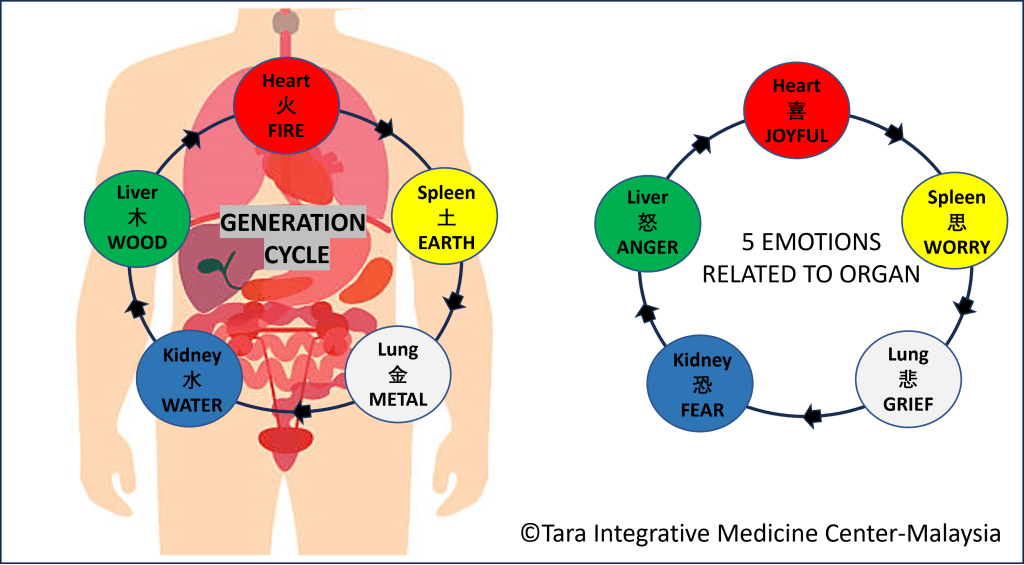
Our organs are not standalone machine but works in tandem with each other to create a harmonious functioning human body which is capable of accomplishing anything including enlightenment.
According to Chinese Medicine concept, our organs are interdependently connected. A weakness of an organ affects the other. In the picture shown here, a generation cycle indicates the flow of Qi from an originator organ to the subsequent organ. When there is a disruption of flow of Qi, a disease will manifest but may not lead to symptoms that we experience.
Treating Root Cause – Not The Symptoms
Therefore when conventional doctors treat symptoms, they may not be treating the root cause as the cause of the disease could be an inter-related problem. So, in our treatment modality we identify the root source of the issue and address it through acupuncture and medicine that is tailor made for the condition.
Organ has intrinsic Yin- Yang Balance
Asthenia or any other weaknesses caused by insufficient nutrient in the form of food or even breath can manifest as insufficient Qi. This disrupt the harmony of each organ. In each organ, an intrinsic Yin and Yang balance exist to create a working condition for the organ. A disruption of this balance creates a condition call False Yang or Deficient Yin. Restoring this balance is required to bring back health to the organ and subsequently the whole body; therefore time is required to see the effect of treatment especially in condition where symptoms do not exist or masked by other condition.
5 Emotions and 5 Organ
Chinese Medicine emphasize on treating patient in a wholesome manner that is both physical and psychological. A patient wellbeing and their feedback is more important than just looking at clinical reports or transferring the patients to other specialty to address other conditions.
According to the chinese medicinal text, when an organ is imbalanced a manifestation of emotions arise. For example, a person who is in grief will certainly cry and their nose will have discharge. ( Nasal passage is part of the lung system) The breath drawn is interrupted in severe crying with the need to inhale harder. Hence according to the chart shown here, the lung organ is affected.
Since every organ is interconnected, an organ with a failed function will certainly bring about a need for other organ to compensate. Do note here the failure of organ IS NOT SIMILAR TO CONVENTIONAL interpretation of organ failure.
Fail function in Chinese Medicine can mean the disruption of Qi flow, the existence of Xie Qi ( Bad/Evil Qi), the lack of Qi( deficiency), over active Yang (False Fire) . All these factors affect the energy of the organ and do contribute to the overall weakening of the organ. I.e Kidney deficiency patients diagnosed with chinese medicine may already have a lower GFR rate or microalbuminuria if they are also subjected to clinical blood test. But in these patients, symptoms may not show yet but eventually it will lead to kidney failure if not addressed.
Chinese Medicine Is Also Empirical
The common misconception of chinese medicine is that it is not empirical. Far from it, a chinese physician is required to determine a disease condition through checking upon multiple system ( tongue and pulse diagnosis, excretion diagnosis. In fact in Japanese Acupuncture system, the patients’ feedback is tantamount to the success of the therapy.
During the diagnosis of a root cause through treatment success or failure a chinese physician can also use this a method to evaluate the accuracy of the diagnosis and still make changes to the treatment modality as the treatment given are not as invasive as chemical based therapy of modern medicine. Chinese medicine after all are plant based and is a kind of nutrition therefore taking longer to take effect.
East meets West
Choosing a trained physician in both conventional and chinese medicine is important as this can eliminate the risk of delaying serious acute condition that require surgical or hospitalisation care.
Conversely , for chronic condition, treating the symptoms only (i.e. steroid /antihistamine) are just “scratching the surface” and not addressing the root source problem. Since Qi weakness of any organ cannot be measured using blood or urine test a conventional physician may find it hard to determine the cause.
Functional medicine physician are trained to look at root cause and the treatment plan are never a pop of a magic bullet pill but a long journey to restorative health using nutritional and preventative solutions.
Patient Emancipation
Do not let a disease, a physician or even a medical report dictate your health and outcome. You are in control; if you want it.
Our body is ours and we are the guardian. We should be able to decide for ourselves the most suited treatment with the aid of a trained clinical physician in conventional and alternative approach. The aim is to bring back the harmonious function of all our organs to create health from within.
Subscribe
Enter your email below to receive updates.
 Tara Integrative Medicine Clinic